

Why You and Your Partner Keep Having the Same Fight Over and Over
It is 11:40 on a Tuesday night. The argument ended an hour ago and you are still replaying it. You know how it started. You know how it always starts. And under the replay sits the thought that scares you more than the fighting does: nothing ever changes.
Couples often repeat the same fight because the surface topic activates an underlying pursue-withdraw cycle involving needs for safety, respect, closeness, autonomy, or reassurance. The cycle changes when partners name the pattern, reduce escalation, and repair earlier.
If you and your partner keep having the same fight over and over, the fight itself is not your real problem. The real problem is what the fight keeps hiding. Couples do not stay stuck because they argue. They stay stuck because every round points them at the wrong target: the topic, instead of the pattern underneath the topic.

I am Dr. Ehsan Adib Shabahang a couples therapist located in Cambridge, Massachusetts. This cycle sits in my office every week. Here is what is actually happening inside it: why it repeats, what it protects, and what it takes to break it.
Where Each Partner’s Activation Peaks
The pursuing partner becomes more activated as emotional distance increases, while the withdrawing partner becomes more activated as conflict and pressure intensify. Each protective response can amplify the other partner’s distress.
The hidden pattern
The topic changes. The fight doesn’t.
“I asked you once. The sink is still full.”
Underneath, the same choreography
- A need goes unspoken.
- It comes out as a complaint.
- The complaint lands as an attack.
- The attack meets a wall.
- The wall becomes proof it was never safe to speak.
of relationship conflict is perpetual (Gottman Institute). Lasting couples don’t solve the topic. They learn to name the pattern.
Why do couples keep having the same fight?
Couples keep having the same fight because the argument is about the surface topic while the pattern is about something underneath it: a need that goes unspoken, a fear that gets protected, a wound that gets touched again. Until the pattern is seen and named, the topics keep rotating and the fight stays the same.
Notice what your fights have in common. The dishes version. The phone version. The in-laws version. The money version. Different topics, same choreography: the same opening move, the same escalation, the same two positions at the end, one of you pushing to be heard and one of you gone somewhere behind the eyes.
That sameness is information. Solvable problems get solved; couples work out schedules and dishwashers all the time. A fight that survives every solution is not a problem waiting for better logistics. It is a pattern doing a job. It repeats because something underneath it has never been said out loud, and the argument is the closest either of you can get to saying it.
It was never about the dishes
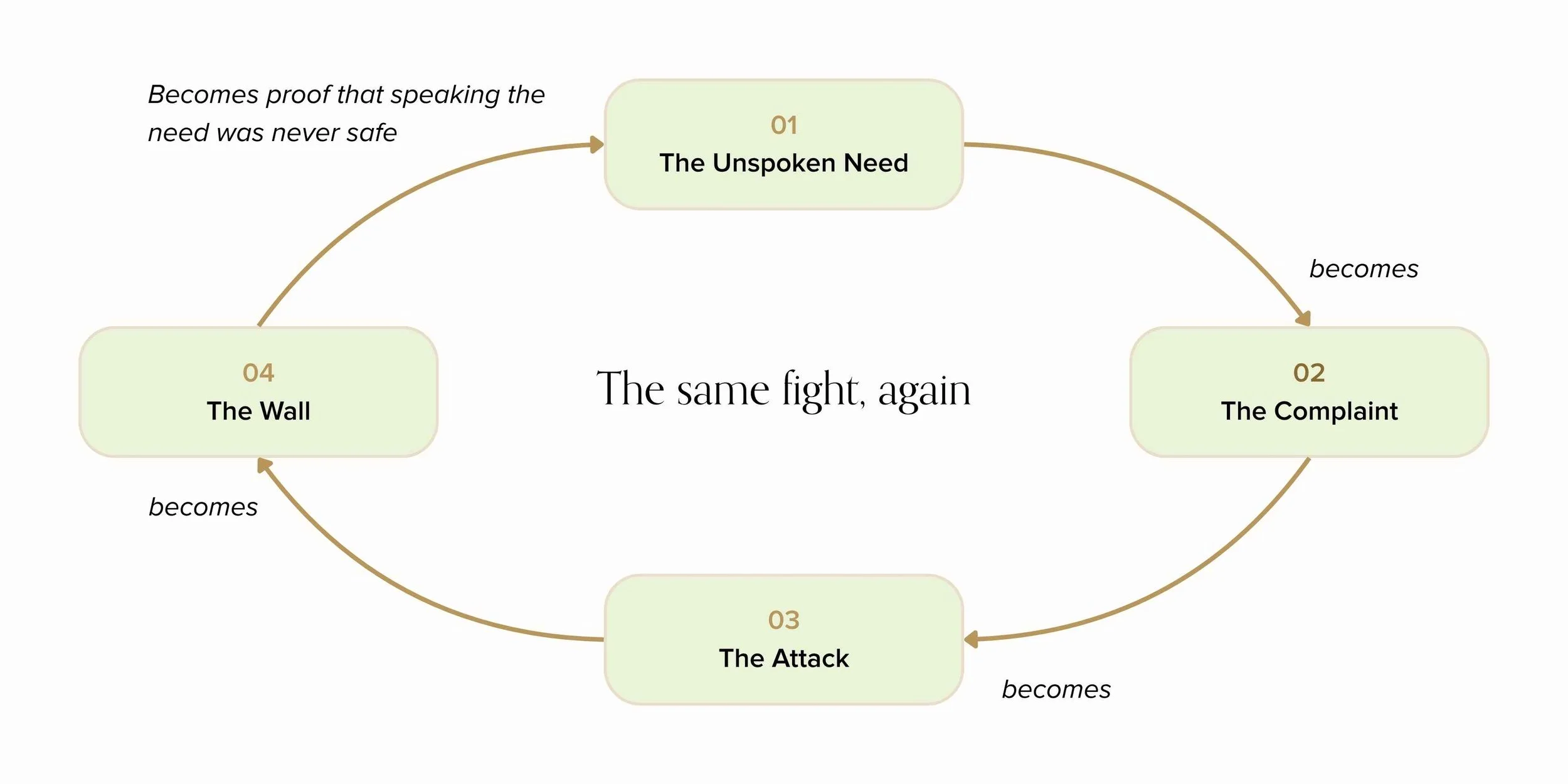
Recurring Conflict Cycle
The topic may change, but the pattern often stays the same: an unspoken need becomes a complaint, the complaint becomes an attack, and the attack meets a wall.
Slow the fight down and look inside it, one partner at a time.
One of you pursues. You raise it again, push harder, get sharper, because being unheard feels unbearable, and silence feels like watching the relationship slip while you stand there. If you do not push, who will?
The other withdraws. You go quiet, concede to end it, leave the room, because the conflict itself feels unbearable, and nothing you say seems to land anyway. If everything you offer is wrong, why offer anything?
Even Healthy Couples Fight — the Difference Is How | Julie and John Gottman | TED
Can conflict actually bring you and your partner closer? It depends on how you fight, say Julie and John Gottman, the world’s leading relationship scientists. They share why the way couples fight can predict the future of their relationships — and show how anybody can transform conflict into an opportunity for deeper connection and understanding.
Demand-withdraw pattern
Researchers call this the demand-withdraw pattern, and it is one of the most reliably corrosive dynamics couples research has documented. A meta-analysis of 74 studies covering more than 14,000 couples linked it to worse outcomes for the relationship and for both partners (Schrodt, Witt, and Shimkowski, 2014). The classic studies add a detail worth sitting with: the partner who wants change tends to demand, the partner who prefers things as they are tends to withdraw, and the roles can swap depending on whose issue is on the table (Christensen and Heavey, 1990).
Research from emotionally focused therapy describes what powers the loop: each partner's protective move sets off the other's alarm. The pursuit that means "I am fighting for us" lands as attack. The withdrawal that means "I am preventing something worse" lands as abandonment (Johnson and Brubacher, 2018). Around it goes.
One moves closer because distance feels dangerous. The other moves away because closeness feels dangerous. neither is trying to destroy the relationship, but together they keep recreating the same wound.
“When the pattern is seen, the relationship has a chance to change.”
Your feelings mid-fight are not noise. They are coordinates. In an observational study of couples in conflict, frustrated autonomy, the sense of being controlled or managed, showed up as anger and irritation, while frustrated closeness, the sense of being unseen or unimportant, showed up as hurt, sadness, and disappointment (Pirrone, Sels, and Verhofstadt, 2023). The feeling names the need.
Here is the chain I watch couples live out:
The need you do not speak becomes a complaint. The complaint becomes an attack. The attack becomes a wall. The wall becomes proof that speaking the need was never safe to begin with.
And underneath all of it, one more truth: in the middle of the fight, you are almost never reacting only to your partner. You are reacting to something older that the moment touched.
Most recurring conflict does not get "solved," and that is not the bad news it sounds like
“It takes two people to create a pattern, but only one to change it.”
According to the Gottman Institute's research, 69 percent of relationship conflict is perpetual. Not 69 percent of conflict in failing relationships. Sixty-nine percent of relationship conflict, period, rooted in lasting differences in personality and in what each person needs from life. Every couple has perpetual problems. Including the couples you envy.
Read that again, because it changes the question. If most recurring conflict never fully resolves, then "we still argue about this" is not evidence of failure. The couples who last are not the ones who eliminated their perpetual problems. They are the ones who changed their relationship to those problems: what the Gottmans describe as moving from gridlock to dialogue, where the same old issue can be discussed with warmth, even humor, instead of contempt.

You do not graduate from the topic. You change how the two of you stand in front of it.
The Hidden Pattern: why every round feels like starting over
In Self-Reflective Relationship Therapy (SRRT), the framework I developed, this repeating cycle is called the Hidden Pattern: the repeated relational cycle that continues until it is recognized, understood, and interrupted. Hidden is the operative word. The pattern survives by staying out of sight, dressed up as tonight's topic.
And the Hidden Pattern has a favorite trick. Every round of the fight tells you that you are back at zero.
You know the feeling. The fight ends and the years of work seem to vanish. The repairs that held, the closeness you rebuilt, the rounds you handled better than you used to: gone, erased by one bad Tuesday. So one of you concludes nothing has changed, and the other concludes there is no point in trying.

The fight does not erase what you have built. It hides it.
That is the illusion the pattern feeds on. The fight does not erase what you have built. It hides it. A couple that gives up inside that illusion gives up at the exact moment repair was still available, standing on a foundation they can no longer feel.
This is also why the recurring fight is worth listening to, not just ending. In SRRT, the relationship works like a mirror: the fight that keeps returning shows each partner where their own reflection is needed. What am I protecting? What have I stopped saying? What impact am I having that I do not want to see? The pattern is not only the injury. It is the map.
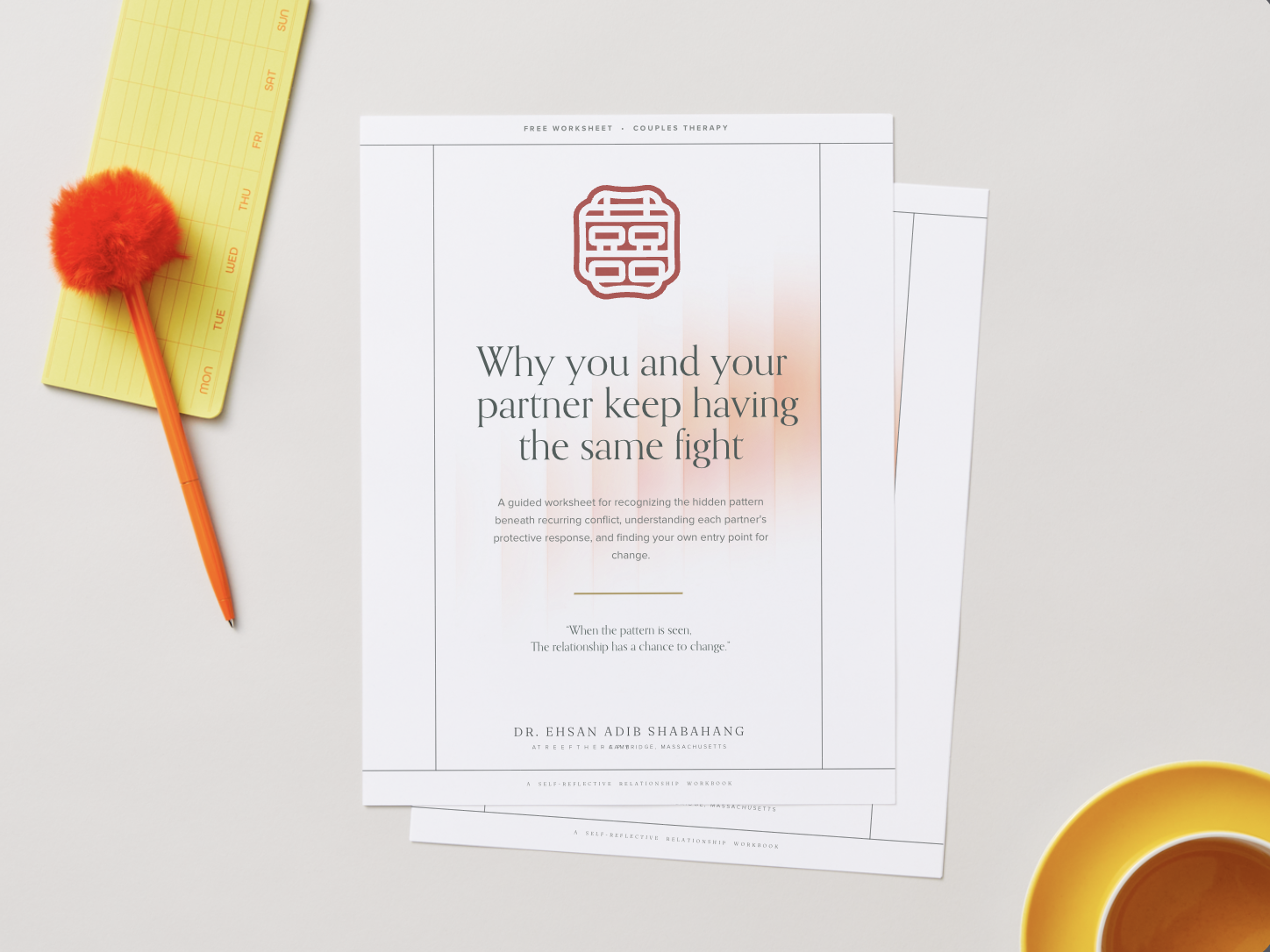
FREE 4-PAGE COUPLES THERAPY WORKSHEET
Map the Pattern Behind the Fight You Keep Having
Download this free couples conflict worksheet to identify the pursue-withdraw cycle beneath recurring arguments, understand the protective responses that keep the pattern going, and work through four self-reflection questions before your next conflict.
Inside the worksheet:
A visual map of the recurring conflict cycle
The pursuing and withdrawing responses
Five ways to interrupt the pattern
Four guided reflection questions
Free PDF · Four pages · No email required
How to stop having the same argument with your partner
There is no clean exit from a pattern with years of momentum. But there are moves that interrupt rounds, and interrupted rounds, repeated, are how patterns lose their power.
Name the pattern, not the topic. The most useful sentence a stuck couple can learn is some version of "we are doing the thing again." Not "you always." A name for the loop itself. Couples research calls this externalizing the cycle: the pattern becomes the opponent, instead of the person across from you (Wiebe and Johnson, 2016). You cannot fight the choreography and each other at the same time. Pick the choreography.
Find your own entry point. You cannot make your partner self-reflect. You can only open your own side. Three questions, asked honestly, change more rounds than any communication script: What am I protecting right now? What am I not saying? What does my reaction spare me from feeling? If the answer embarrasses you a little, you have found it.
Interrupt earlier. Repair sooner. John Gottman defines a repair attempt as any statement or action, silly or otherwise, that keeps negativity from escalating out of control. Timing decides most of it: his lab reported it could predict the outcome of a fifteen-minute conflict conversation from its first three minutes about 96 percent of the time (Carrère and Gottman, 1999). The window is early. A soft start, a touch on the arm, a "wait, let me try that again" in minute two will beat a perfect apology on Thursday.
Stop keeping score. After enough rounds, resentment becomes a filter. Research on negative sentiment override found that distressed partners begin reading neutral, even positive, moments as hostile (Hawkins, Carrère, and Gottman, 2002). Which means that mid-fight, you are sometimes responding to the archive, not to the person in front of you. When your reaction is bigger than the moment, ask what the reaction is actually keeping score of.
Treat "we're back at square one" as a feeling, not a fact. After a bad round, your mind will discount everything the two of you have built and hand you a zero. Do not sign for it. The repairs that held are real. The rounds you handled better are real. Standing on that foundation, and acting from it instead of from zero, is what breaking the pattern looks like from the inside.
One honest limit. These moves interrupt rounds; they do not usually dissolve an entrenched pattern on their own. When contempt has entered the room, or every attempt collapses within a week, needing more than self-help is not a verdict on you or your partner. It is information about how deep the pattern runs.
How to STOP Fighting in your Relationship!
Conflict absolutely makes or breaks your relationship. How we fight makes a HUGE difference. In this episode I talk about what relationship experts say is the best way to fight or navigate conflict in our relationships, with empathy, active listening, validation, emotional safety and consideration so that it doesn't tear us apart.
When the same fight means it is time for couples therapy
Take the signals seriously. The same argument has run for months or years, and repair takes longer after each round. Mockery, eye-rolling, or disgust has entered the fights; Gottman's research identifies contempt as the strongest single predictor of a relationship coming apart, which makes it a reason to act, not a sentence. Or the fighting has stopped because the trying has stopped, and the quiet in the house is starting to feel permanent.
Waiting rarely helps. You may have heard that couples wait an average of six years before seeking help. That figure comes from Gottman's clinical writing; a newer peer-reviewed study found the average closer to two to three years (Doherty, Harris, and Hall, 2021). Either way the direction is the same: patterns calcify, and earlier is easier.

Conflict as pathway to connection
Here is what I will not tell you: that therapy fixes marriages. No ethical therapist can promise an outcome. What the research supports is more modest and more real. Couples therapy positively impacts roughly 70 percent of couples who engage in it (Lebow, Chambers, Christensen, and Johnson, 2012), and outcomes depend on timing, on the approach, and on both partners' willingness to look at their own side of the pattern.
That last part is the fit question. My practice is built for couples who still care about the relationship and are willing to do that looking. The work is structured and progress is tracked. I draw on the Gottman Method, in which I am Level 2 certified, and on SRRT, and I keep my caseload deliberately small. If the pattern in this article is your pattern, start with a free 30-minute consultation: a real conversation about what is happening, not a sales call. I work with couples online across Massachusetts, from Cambridge and Boston to the rest of the state, and I am also licensed in Texas, Florida, North Carolina, South Carolina, and Michigan.
Waiting doesn't change the pattern. Seeing it can.
〰️
Waiting doesn't change the pattern. Seeing it can. 〰️
Learn more about couples therapy at AtReef
Frequently Asked Questions About Repeating Arguments in Relationships
-
Couples often repeat the same argument because the visible topic is not the entire conflict. The disagreement may appear to concern chores, money, parenting, intimacy, or time together, while the emotional pattern underneath involves feeling ignored, criticized, controlled, rejected, unsupported, or unimportant. Until that underlying pattern is recognized, changing the topic rarely changes the outcome.
-
The pursue-withdraw pattern occurs when one partner pushes for discussion, reassurance, or change while the other becomes quiet, defensive, emotionally unavailable, or physically distant. The more one partner pursues, the more overwhelmed the other may feel. The more the other withdraws, the more abandoned or unheard the pursuing partner may feel. Each person’s attempt to protect themselves unintentionally intensifies the other person’s reaction.
-
Small disagreements become major fights when the present issue activates a larger emotional meaning. A forgotten task may be experienced as evidence that one partner does not care. A request may be heard as criticism or control. Once the argument becomes connected to older hurt, accumulated resentment, or fear about the relationship, both partners begin responding to more than the immediate event.
-
Start by naming the pattern rather than accusing the other person. Saying, “I think we are getting pulled into the same cycle again,” is more useful than saying, “You always do this.” Slow the conversation down, identify what each person is feeling, and translate criticism or withdrawal into the underlying need. The goal is not to settle every issue immediately. The first goal is to prevent the familiar cycle from taking over.
-
A break can be healthy when it is clearly communicated, time-limited, and followed by a return to the conversation. It becomes avoidance when one partner disappears, uses silence as punishment, or never comes back to the issue. A useful break sounds like: “I am too overwhelmed to continue well. I need 20 to 30 minutes, and I will come back so we can finish this conversation.”
-
Not necessarily. Most long-term couples have recurring differences that are never eliminated completely. More concerning signs include contempt, intimidation, emotional indifference, repeated threats to end the relationship, an inability to repair after conflict, or one partner carrying all responsibility for change. The existence of a recurring disagreement matters less than what happens between you while you are having it.
-
One partner can interrupt their own part of the pattern, but one person cannot create mutual accountability, emotional safety, or lasting repair alone. Changing how you begin a conversation, respond to criticism, manage defensiveness, or set limits may alter the cycle. However, the relationship can only change fully when both partners become willing to examine their impact and respond differently.
-
Couples therapy may be appropriate when the same conflict has continued for months or years, conversations repeatedly become hostile or shut down, repair takes longer after every argument, or both partners understand the problem intellectually but cannot change it in the moment. Therapy can help identify the pattern, clarify what each partner is protecting, and create a structured way to practice different responses.
-
Recurring conflict should not be treated as an ordinary communication cycle when it includes fear, coercive control, threats, stalking, sexual pressure, property destruction, financial control, or physical violence. These are safety and power concerns, not simply shared communication mistakes. In those circumstances, individual support and specialized domestic violence resources may be more appropriate than joint couples therapy.

About the author:
Dr. Ehsan Adib Shabahang, LMHC, is a couples and individual psychotherapist, author, researcher, and founder of AtReef Therapy in Cambridge, Massachusetts. He created Self-Reflective Relationship Therapy (SRRT), a research-informed framework focused on self-awareness, emotional safety, accountability, communication, and relational repair. Dr. Shabahang has completed Level 2 Training in Gottman Method Couples Therapy and works with couples and individuals navigating recurring conflict, emotional disconnection, relationship patterns, and difficulties rebuilding trust and closeness.
Sources
The Gottman Institute. Managing Conflict: Solvable vs. Perpetual Problems. https://www.gottman.com/blog/managing-conflict-solvable-vs-perpetual-problems/
Schrodt, P., Witt, P. L., & Shimkowski, J. R. (2014). A meta-analytical review of the demand/withdraw pattern of interaction. Communication Monographs, 81(1), 28-58. https://doi.org/10.1080/03637751.2013.813632
Christensen, A., & Heavey, C. L. (1990). Gender and social structure in the demand/withdraw pattern of marital conflict. Journal of Personality and Social Psychology, 59(1), 73-81. https://doi.org/10.1037/0022-3514.59.1.73
Johnson, S. M., & Brubacher, L. (2018). Clarifying the negative cycle in emotionally focused couple therapy. https://cls.unc.edu/wp-content/uploads/sites/3019/2018/12/Clarifying-Negative-Cycle-ECFT-2018.pdf
Pirrone, D., Sels, L., & Verhofstadt, L. L. (2023). Relational needs frustration: An observational study on the role of negative (dis)engaging emotions. Frontiers in Psychology. https://doi.org/10.3389/fpsyg.2023.1232125
Wiebe, S. A., & Johnson, S. M. (2016). A review of the research in emotionally focused therapy for couples. Family Process, 55(3), 390-407. https://doi.org/10.1111/famp.12229
Carrère, S., & Gottman, J. M. (1999). Predicting divorce among newlyweds from the first three minutes of a marital conflict discussion. Family Process, 38(3), 293-301. https://doi.org/10.1111/j.1545-5300.1999.00293.x
Hawkins, M. W., Carrère, S., & Gottman, J. M. (2002). Marital sentiment override: Does it influence couples' perceptions? Journal of Marriage and Family, 64(1), 193-201. https://doi.org/10.1111/j.1741-3737.2002.00193.x
Doherty, W. J., Harris, S. M., & Hall, E. L. (2021). How long do people wait before seeking couples therapy? Journal of Marital and Family Therapy. https://doi.org/10.1111/jmft.12479
Lebow, J. L., Chambers, A. L., Christensen, A., & Johnson, S. M. (2012). Research on the treatment of couple distress. Journal of Marital and Family Therapy, 38(1), 145-168. https://doi.org/10.1111/j.1752-0606.2011.00249.x
Escudero, V., et al. (2024). A research-driven flowchart to approach change in couples. Frontiers in Psychology. https://www.frontiersin.org/journals/psychology/articles/10.3389/fpsyg.2024.1438394/full
Read more quotes from Esther Perel. https://www.goodreads.com/quotes/8933681-it-takes-two-people-to-create-a-pattern-but-only